Yes, And: Math as Play
 February 25, 2026 | Post by : Matt
Embrace the Concepts of Improv to Build Community, Spark Student Curiosity, and Improve Instructional Planning
Live and local comedy performances come in a variety of forms — some are structured like scripted plays, others focus on joke-telling through “stand up sets”, and some center techniques based on improvisation.For this third category of performances — i.e., “improv shows” — there is no script and no standard “set” for a comedian to recite. Instead, all action is made up on the spot, typically through audience suggestion or other inspirations. Those who watched a lot of TV in the late ’90s and early ’00s, for example, may remember improv as consisting of short bits like this from the show, Whose Line Is It Anyway? Alternatively, improv can be used to also tell longer narratives, an approach that has taken on greater prominence in recent years. Either way, neither is better or worse than the other. Each style has its place depending on the audience.
That said, the elements and structure that make an improv show memorable — regardless of its short- or long-form approach — can also help create a vibrant math classroom where students can embrace their creativity and curiosity while having fun, and teachers have new ways for students to engage with the content.A good improv comic does not just step on stage and work without any rules in mind to help transform a mediocre scene into a great one. These same rules can also apply to teaching and learning math.In his foundational book, How to Be the Greatest Improviser on Earth, Will Hines offers eight “rules” to improve one’s improvisation skills:

Be Present: Stop thinking ahead, but instead be in the moment, genuinely observing and reacting to what others are saying and doing.
Be Changeable: be willing to adjust in the moment to what others offer in a scene.
Be Brave: Be willing to “Follow the Fear” and make a choice, no matter if you think it’s necessarily the “right” or “wrong” choice.
Fight Well: Be ready to be wrong in a scene and to find interesting ways to disagree with what others say or do.
Play With Difficult People: There will always be other players who provide some level of chaos, both on and off stage, so learning how to deal with this and perhaps even enjoy the chaos are necessary skills.
Be Authentic: Playing authentically – bringing in your real self into a scene where you commit to the world and character you are creating – often makes for the most engaging and enjoyable scenes.
Be Funny: to be a great improviser, you have to be funny! Funny ideas, good timing, and the ability to spot when something unusual happens makes for a funny performer.
Be Healthy: Be kind to yourself as a performer, strive for a good performance/life balance, and do not give up when challenges arise.
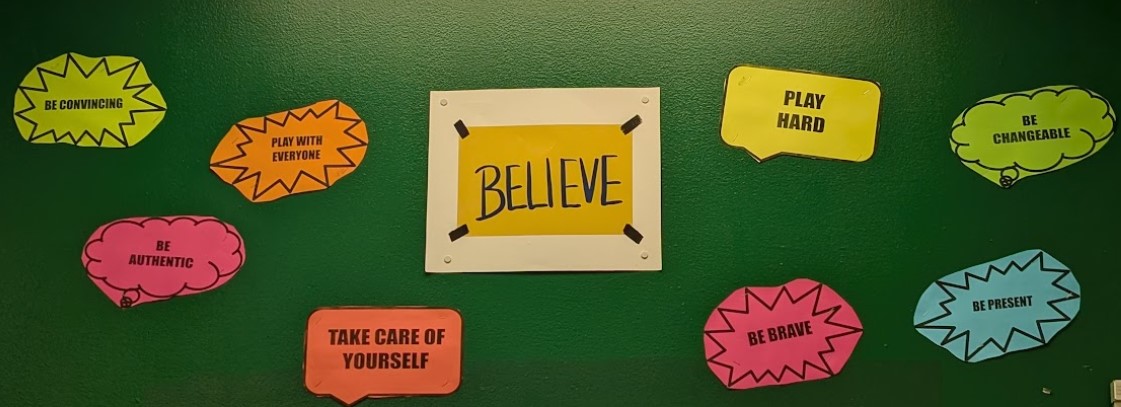
After studying these “rules” for my own improv work, I have since adapted them as norms for my math students to follow in class:

**I leave it open to intepretion how these classroom norms connect to the improv rules so that they can best fit to each teacher’s own classrooms.These eight norms help to “set the stage” for an environment where students work together, communicate their reasoning to each other, and have fun while working through problem sets, for example.For the remainder of this post, I will outline some games, strategies, and resources that leverage these norms so that teachers can build community, reinforce mathematical topics, and introduce new topics.
Warm Up Games: Build community, have fun, and increase student energy
It is crucial that our math classrooms are seen as a places where students feel safe and welcomed. One way to do that is through the use of Warm Up Games, which does not always need to have a curricular focus. Some examples games include “Zip Zap Zop” (but with students’ names instead of zip/zap/zop), “Protest Chant”, and “Crazy Eights”. More are available through the New York Improv Theater.
Short Form Games: A way to reinforce mathematical topics and vocabulary
After students learn a topic, they need ways to interact with the material and reinforce what has been taught and learned. Adapting short form games can provide the opportunity for this reinforcement. The following is a sample of how some games could be adapted for the classroom:

Long Form Structures: A way to Introduce new concepts
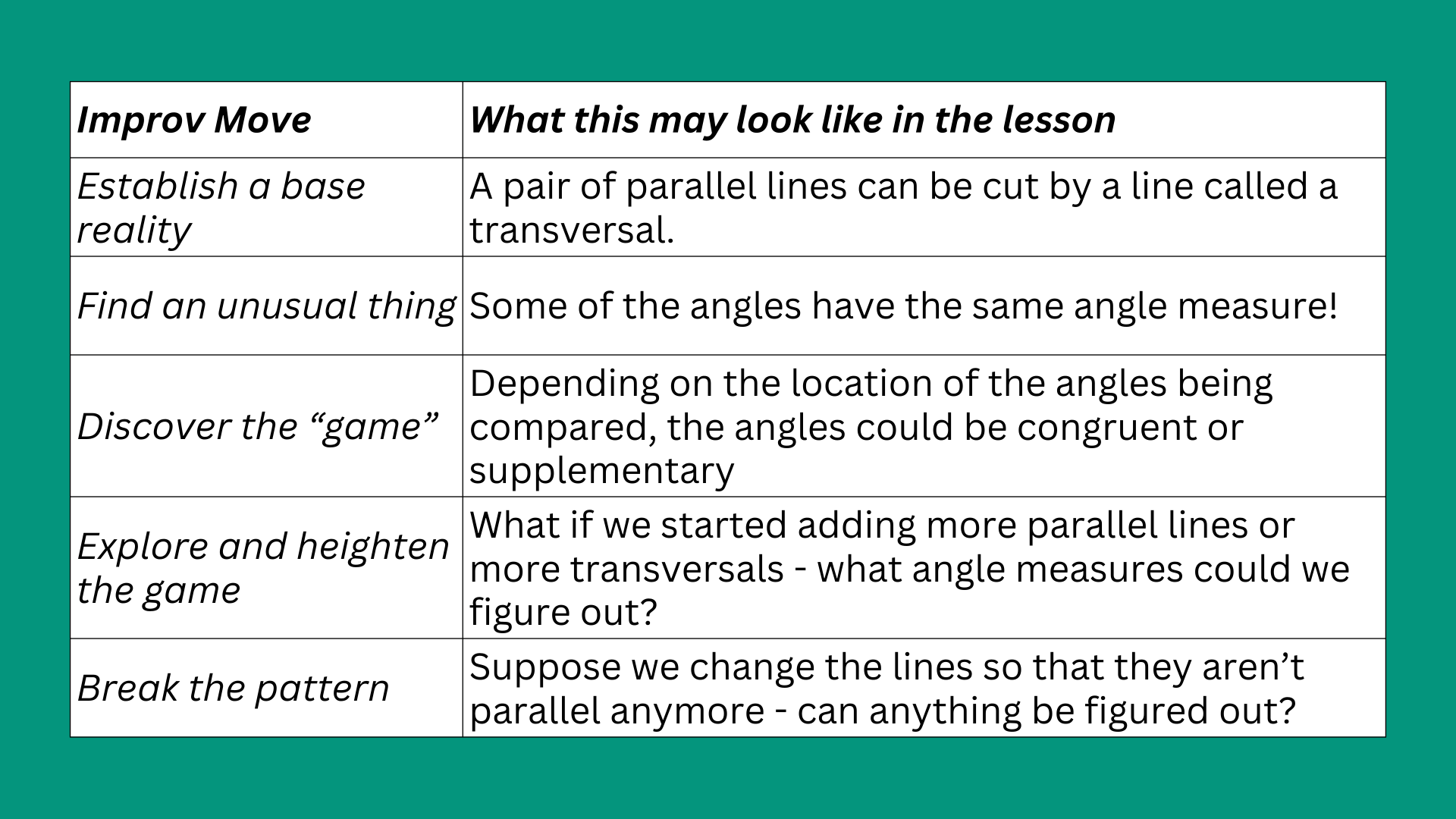
In the math classroom, teachers are often looking for new, unique, engaging ways to introduce topics. Some teachers embrace Building Thinking Classrooms and Thin-Slicing at Vertical Whiteboards, while others take a Problem-Based Learning approach or use Dan Meyer’s 3-Act Structure. And then there are teachers who are looking for something entirely different. For these folks, structuring a lesson as long-form improv could work in their classrooms.When improvising an engaging scene, a pair of performers often does the following: establish a base reality, discover the “first unusual thing” that will make the scene interesting, and find the “game” of the scene, i.e., the scene’s plot and where the comedy comes from that. The improvisers then explore and heighten the game until the game comes to a natural conclusion and can’t be heightened anymore. At this point, the improvisers break the pattern and may choose to end the scene or explore something different. In much the same way, teachers can use this structure to design their lessons.
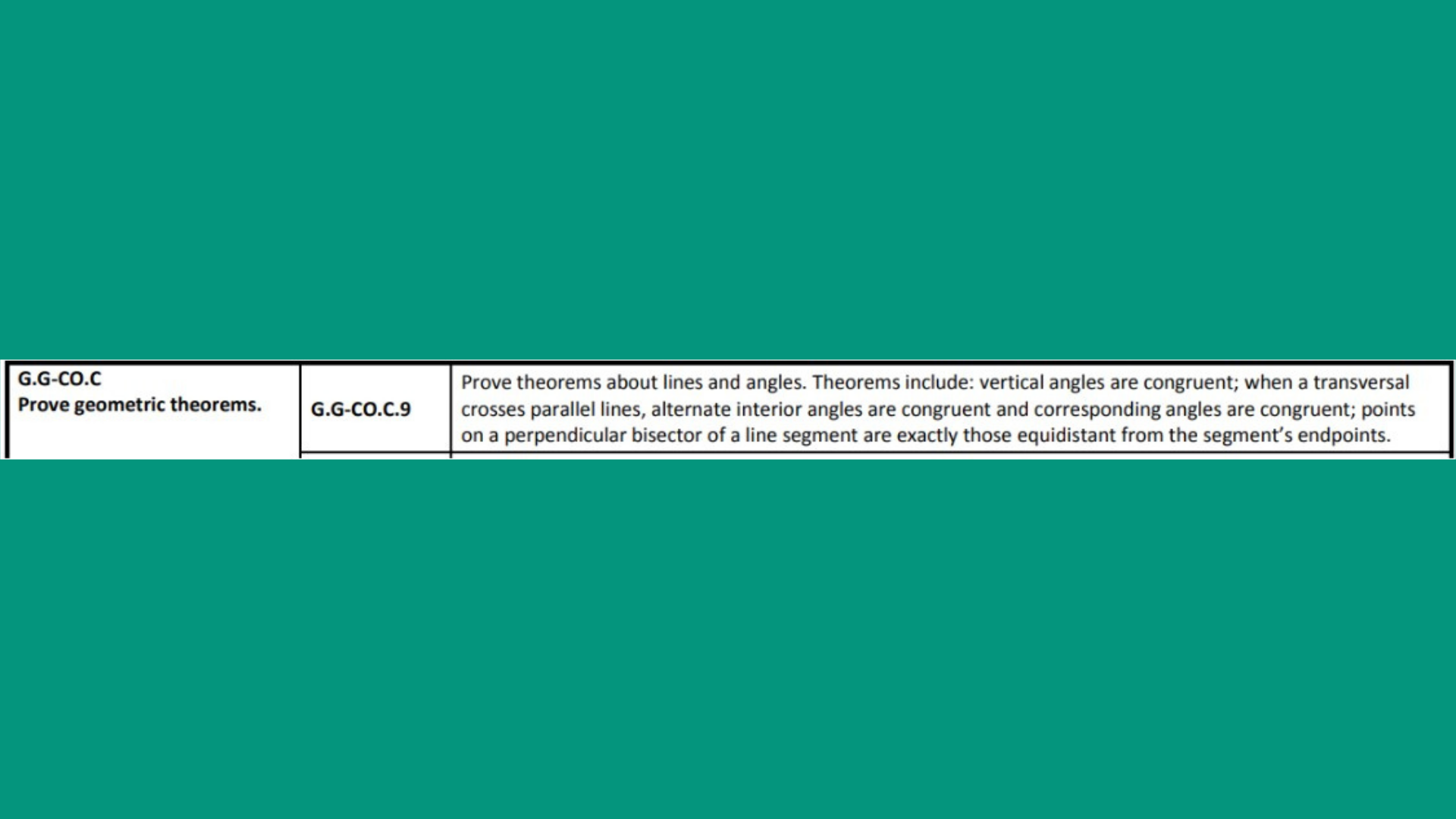
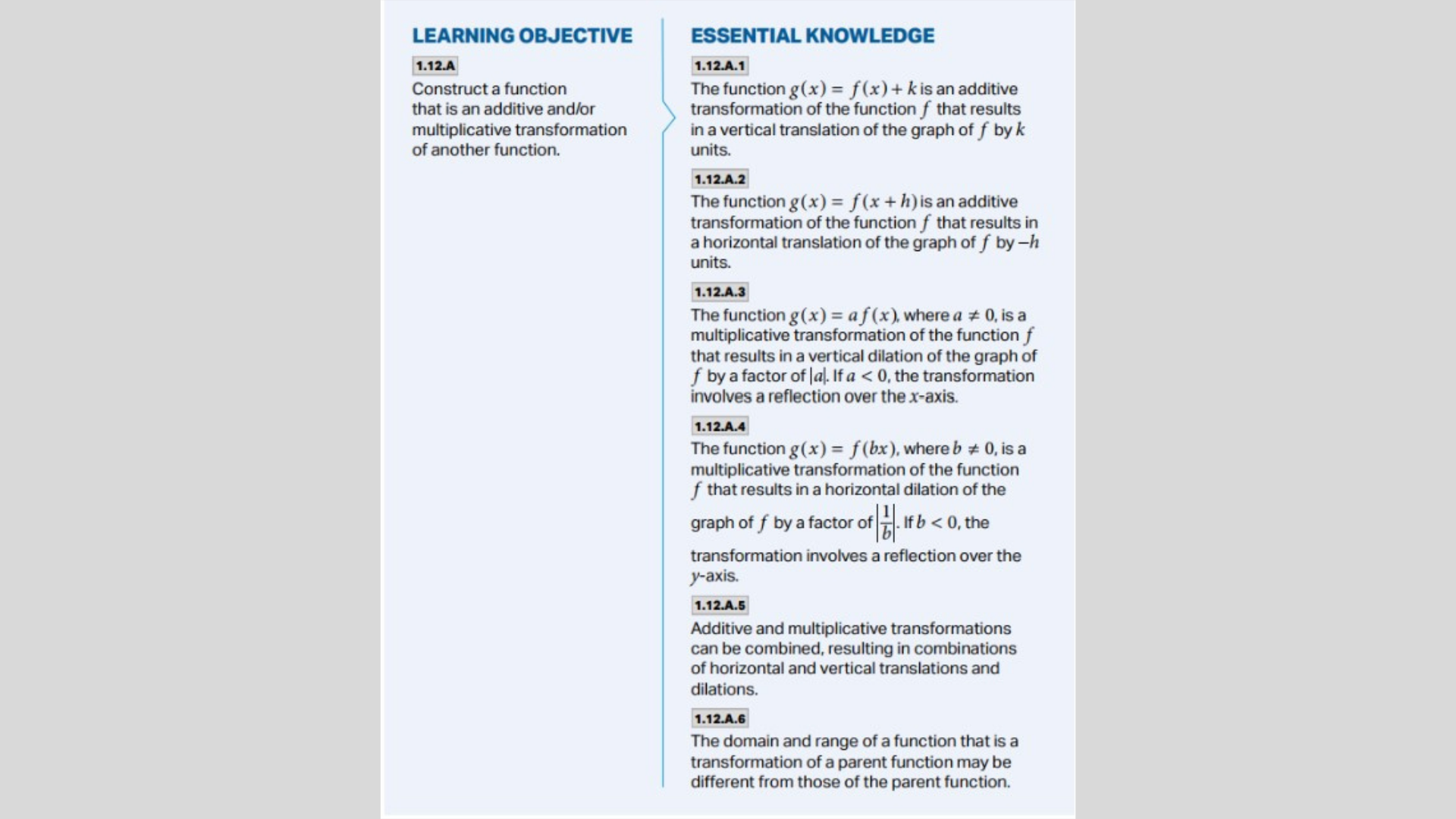
The following are examples of deploying this method in (1) an eighth grade math class, (2) Geometry, (3) Algebra 1/Algebra 2/Precalculus, and ($) Calculus. The corresponding Arizona State Standards or appropriate AP standards are also listed with each example.
Eighth Grade:


Geometry
Algebra 1/Algebra 2/Precalculus


Calculus


As you can see, this structure can be used for nearly any standard and provides a way for us as teachers to make sure we are starting at the base knowledge of what students need to know for the standard, finding the interesting and unusual concepts along with our students, and helping them build these concepts into something new and even more interesting.Experienced improvisers make the art look so easy and effortless, while providing the audience with laughter and entertainment. They are able to do this because they know what rules to follow and how to play with what’s been given to them. Likewise, we as math teachers can set up our classes in such a way that students are willing to work with each other, try new things, and have fun playing with math — all with the hope that they will want to continue learning (and playing with) math throughout their educational career.

About the AuthorMatt Collins has been teaching high school math in Arizona at all levels since 2010. He’s happy to connect with you and discuss how we can help students play with math at mcollins@tanq.org.
Related Post

January 9, 2025 | Post by : Cerelo
Roots & Marigolds: My International Teaching Odyssey By: Cerelo Villagracia Flores, Ph.D. It might surprise you that many of the teachers in the United States are not American citizens; like myself, international teachers abound in the country of the Star Spangled Banner. This became a reality in 1961 when the Mutual Educational and Cultural Exchange…
Learn More

March 7, 2023 | Post by : Jen
Thank you Tucson Region Educators! By: Jen Kinser-Traut, Ph.D. “Within TREC I found a breath that blew life into who I was as a teacher. It gave us a new purpose, a group that was going to help bring that change around, a place to belong to as a teacher and not as part of…
Learn More

January 21, 2026 | Post by : Amy Ruth
Enhancing the knowledge of peers is not only exciting and rewarding — it can also be overwhelming. In this blog post, you’ll find proven practices to better equip you for working with adult learners generally and teachers specifically. Included below are checklists for facilitators to plan their professional development (PD) session and to coordinate with…
Learn More