The Human-AI Partnership in 2026: What Excites Me Most About Using Artificial Intelligence in my Teaching
 March 23, 2026 | Post by : Karyn
My goal with this post is to (1) model transparency, (2) empower thoughtful Artificial Intelligence (AI) use, (3) and make AI feel approachable — not intimidating — for educators.
To start, I keep pedagogy first, not tools first. AI is not my teaching plan, my instructional design, or my professional judgment. Instead, it is a tool I weave intentionally into my teaching practice. To do that well, we educators all need greater AI literacy and strong judgment. In short, we need to understand what AI can do, what it should not do, and when it truly supports learning (instead of shortcutting it).
A quick note on transparency
This blog itself was created through an AI–human partnership. I shaped the purpose, message, tone, and final direction (with late-stage edits by TREC staff). AI then supported me with organization, information, refinement, and wording. Furthermore, many of the ideas I share here are adapted from AI Optimism, by Becky Keene, which powerfully frames AI as a collaborative learning partner rather than a replacement for human expertise.
AI as an Idea Catalyst, not a Shortcut
AI cannot think for me; instead, I use AI to stretch my thinking. This means I stay grounded in what humans uniquely bring to the partnership.
What I Do as the Human in This Partnership
Purpose & Pedagogy: I define the learning targets and decide why an AI tool is useful in the first place.
Ethics & Responsibility: I protect privacy, ensure fairness, and model responsible use.
Emotional Intelligence: I know my students as learners. I understand their struggles, personalities, and motivations.
Critical Judgment: I evaluate the AI model’s responses, e.g., is this accurate based on Arizona teaching standards? Is it appropriate for my students’ skill levels? Is it instructionally meaningful to each of my learners?
Creativity & Adaptability: I bring lived experience, originality, personality (humor), and professional wisdom.
What AI Does in the Partnership
AI doesn’t “teach” for me; it supports and amplifies my work. I use it to:
- Generate ideas, drafts, options, and possibilities
- Rephrase explanations or scaffold concepts in different ways
- Differentiate tasks and personalize learning
- Save time on repetitive or administrative tasks
- Help students explore alternative perspectives or approaches
Instead of doing the work for teachers or students, AI helps us brainstorm, expand our ideas, and reflect more deeply.
How This Partnership Plays Out in My Planning
I see AI as part of an interactive thinking loop — not a one-click answer machine. The cycle looks like this:
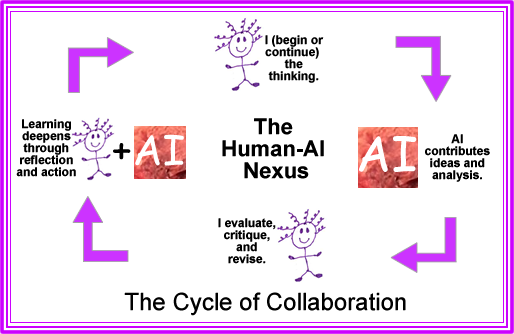
I don’t ask, “What will AI do for me?” Instead, I ask, “How can AI support my thinking?”
Why This Matters
This partnership approach matters because it:
- Keeps learning meaningful and human-centered
- Prevents overreliance and “easy button” shortcuts
- Builds AI literacy and critical thinking skills
- Leads to more creative, inclusive, transformative learning experiences
AI and Bloom’s Taxonomy
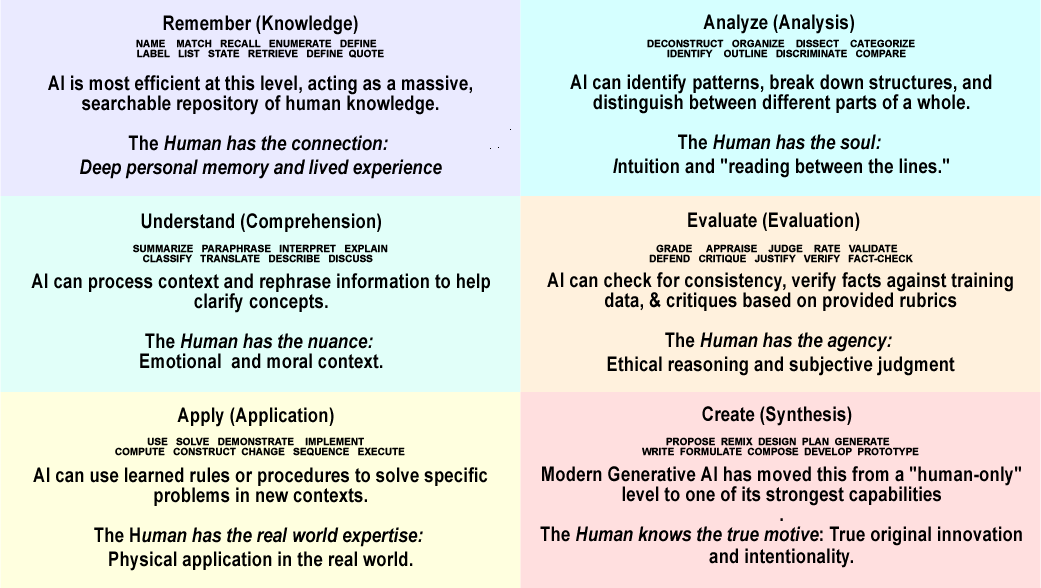
I was first introduced to Bloom’s Taxonomy in 1987, when I took my first teaching classes. For the past 39 years, the same ideas have been reshaped, reformed, and reused — all for the goal of having students learn to think deeper. Now with AI, I continue to teach within the Bloom’s framework, but with the added work of balancing ethical AI use while leveraging its increased computing power.
My first question then when working with AI was the levels of Bloom’s Taxonomy it can support me on and what levels it cannot — so I asked AI directly! Below is an (edited) summary of what AI yielded.
At the end of the day:
- AI supplies capacity
- Humans supply wisdom
- AI then expands possibilities
- Finally, humans decide what matters
Just like this blog — and much like the thinking inspired by AI Optimism — when humans and AI work together thoughtfully, the result isn’t less human. It’s more intentional, reflective, and deeply connected to learning.
All of this sounds great…but what does it look like in my planning and implementation in my classroom? Click here to access a sample choice board inspired by Universal Design Learning (UDL) principles (CAST, 2024). This resource includes insights into using AI to create a choice board in the classroom, and it highlights AI’s strengths and what humans should contribute to the project.
In short, AI offers a powerful win-win opportunity for both educators and students. By leveraging the Human–AI nexus, teachers can efficiently create engaging, high-quality, and up-to-date instructional materials — even within tight time constraints. But to do so, I recommend first starting small so that you can explore practical ways to integrate AI into your teaching bit-by-bit, and in doing so you are able to build confidence with it and see its impact on student learning.
References
Special thanks to Dr. Rebecca Cohen of Pima Community College, who introduced me to the newest UDL Design materials, encouraged me to use and experiment with AI in her classroom, and allowed me to use and share her materials as I developed these resources.
Arizona Department of Education. (2018). Arizona science standards. https://www.azed.gov/sites/default/files/2022/03/Complete%20Set%20of%20Standards%20Doc%203_29_22.pdf
Canva. (2026). Magic Media [Generative AI tool]. https://www.canva.com
CAST. (2024). Universal Design for Learning Guidelines version 3.0. https://udlguidelines.cast.org
Google. (2026). Gemini [Large language model]. https://gemini.google.com/
Keene, B. (2025). AI optimism: A guide to redefining artificial intelligence in education. Dave Burgess Consulting.

About the Author
Karyn White, a National Board-Certified Early Childhood Generalist, has been teaching elementary students in Arizona since 2015. She’s happy to connect with you and discuss the AI-teacher partnership at karyn.white@tusd1.org.
Related Post
January 9, 2025 | Post by : Shay
Take Your Shot By: Shay Humphreys Monitor and adjust. Teachers hear this all the time — and we are masters at it. We do it daily, hourly, by the minute. Sometimes we do it without even realizing. The fortunate part of our work is that when we have an off day or a lesson doesn’t…
Learn More

March 9, 2023 | Post by : Katelyn
Teaching can be an Island; together, we can make an Archipelago By: Katelyn Kelsey, M.A., MEDL Educators—teachers, paraprofessionals, associated support providers, specialized teachers, and administrators—can feel lonely. Sometimes you’re on your own “island” in your classroom with your students and don’t see many adults. Administrators sometimes feel lonely at the top. Even with assistant principals,…
Learn More
January 21, 2026 | Post by : Amy Ruth
Enhancing the knowledge of peers is not only exciting and rewarding — it can also be overwhelming. In this blog post, you’ll find proven practices to better equip you for working with adult learners generally and teachers specifically. Included below are checklists for facilitators to plan their professional development (PD) session and to coordinate with…
Learn More