The Power of Choice, Community, and Cohorts in Professional Learning
 May 1, 2026 | Post by : Katie
As part of my capstone project for TREC Teacher Leader Cohort 5, I set out to implement and analyze the effectiveness of year-long, community-building professional development cohorts for early childhood educators in the Tucson Unified School District (TUSD).
What materialized over the course of the school year was a dynamic, multi-pathway model designed to honor teacher agency.
_____________________________________________________________________________________________________________________
In a preschool department with 180+ early childhood teachers and teaching assistants, meeting together as one homogenous group did not address the individual needs our educators have. To remedy this, the department moved away from traditional whole-group sessions and towards a professional environment for both facilitators and educators that prioritized psychological safety (through small groups) over passive participation.
One of our cohort facilitators, Joncie Shaw, observed that “the small group allowed people to feel a little safer to share their ideas, and the vibe just felt more cohesive.” This sense of safety is the foundation of effective adult learning: in a smaller “circle”, the social risk of speaking up is lowered, allowing educators to move from a defensive posture to a truly reflective one.
By structuring teacher engagement through regularly scheduled small-group interactions, these monthly cohorts also supported professional growth by promoting, as one educator shared, “lots of interactive collaboration, accountability as well as reflection.” This mention of accountability is worth highlighting because it speaks to why we went the cohort route: unlike a one-time workshop, returning to the same peers every 3-4 weeks creates a “soft accountability” where teachers are encouraged to follow through on new strategies. This ensures that professional development is not an isolated event, but a continuous thread that allows educators to bridge the gap between high-level theory and the daily realities of their classrooms.
_____________________________________________________________________________________________________________________
Aside from the preselected educators who participated in the foundational and team-building cohort, Preschool Collaborative, the rest of TUSD’s preschool department was empowered to choose small-group cohorts from a range of specialized tracks:
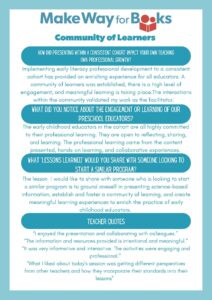
- Make Way for Books, which focused on science-backed early literacy and storytelling strategies;
- Saying YES: Nature, Courage, and Playful Learning, a journey into trusting children through risky and sensory outdoor play;
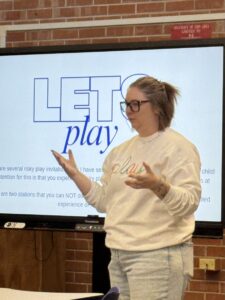
- Let’s Play, an exploration of how the intentionality of the environment sparks language, math, and science concepts;
- Mind in the Making, a collaborative book study diving into the seven essential life skills that shape childhood development; and
- The School Garden Workshop, which provided nature exploration and food literacy curriculum that integrated directly with our district standards.
This balance of prescribed support and professional autonomy allowed us to meet teachers where they were in their careers, embodying the TREC Teacher Leader Competency that Teachers are Professionals who deserve to be recognized as colleagues with their own unique expertise and skill sets.
By allowing teachers to choose their focus, the learning became deeply personal and joy-filled. One participant reflected on this support, stating, “I have never had the amount of heartfelt support in ANY school district than I have in TUSD.” This sentiment was particularly echoed by participants in specialized tracks like the School Garden Workshop, which a teacher highlighted for supporting “curiosity and inquiry instead of worksheets.” They noted that it helped them meet children where they are developmentally and integrate concepts across TELL, a newly mandated curriculum within our department. Similarly, another educator appreciated the year-long theme in their literacy cohort, stating it provided a “safe environment to grow together” in an area they are passionate about.
_____________________________________________________________________________________________________________________
Looking to my own professional development, this environment allowed me to grow as a Teacher Communicator— another TREC Teacher Leader Competency — by practicing active listening and demonstrating an awareness of multiple perspectives within the classroom team. This helped me to value every voice and see that it was a norm we carried into every session I facilitated. As one Teaching Assistant noted, the smaller scale “gave us TA’s a voice that gets lost in the bigger/whole group PD’s.” And so, by democratizing the conversation, we not only fostered a more inclusive workplace but also recognized our teaching assistants as vital co-educators.
Looking to how this approach to PD might be improved for the future, the following visual represents some of the department’s feedback on the cohort structure. Specifically, participants were asked, “Which model would you prefer?”
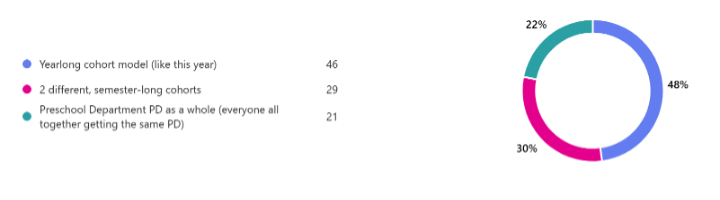
While a near-majority supported the year-long model, my team and I are listening to the nuances in the feedback to further improve our offerings.
For example, some participants noted that “interests can change over time.” In response, my team will look for ways that allow for cross-pollination across cohorts while maintaining the stability and cohesiveness of the small groups.
Educators also emphasized that “PD should be attended by the team in the classroom so that together plans and positive changes can be made”, which we will encourage in the upcoming school year.
Finally, we acknowledge the need for shared foundational knowledge; as one teacher suggested, “licensing and Quality First” information remains a priority that we can integrate to ensure all staff feel prepared.
_____________________________________________________________________________________________________________________
This capstone project has been key to my growth as a Teacher Leader after having anchored the effort in TREC’s four teacher leader competencies.
As I previously mentioned, by viewing Teachers as Professionals, our facilitation team focused on creating a workplace culture that treats the challenges of new implementation as a natural part of professional growth — where the emphasis is on what participants bring to the conversation and not on what they lack, and where teachers have choice and agency.
I grew as a Teacher Communicator, too; but I also embraced being a Teacher Learner, stimulating my own thinking and expanding my content knowledge alongside my colleagues. I agree with one of the cohort’s facilitators, Kyla Maciosek of Nature Created Play, who observed that “depth over breadth matters… [r]eal change [comes] from repetition, reflection, and application over time.”
Finally, this capstone helped me to further embrace my role as a Teacher Advocate, elevating my colleagues’ voices and celebrating their successes by pushing for the continued use of this cohort model. Our teachers’ feedback on these cohorts clearly communicated to me that when we support the individual PD needs of teachers, we will see higher implementation of learned skills than in traditional settings.
_____________________________________________________________________________________________________________________
The lessons from this pilot are clear: building a stronger preschool community requires establishing a culture of learning that moves away from surface-level training to focus instead on meaningful, sustained exploration.
This model has demonstrated that when we honor teacher agency and provide a consistent, safe space for reflection and collaboration, we do more than just improve instructional skills — we sustain the joy and passion that prevents educator burnout. As one participant suggested, building these connections early through intentional team-building is key to starting the school year with a foundation of professional trust.
Moving forward, we will continue to refine our cohort model, ensuring every educator in our preschool department feels empowered, heard, and supported. By investing in small cohorts and the power of choice, we intend to create a more resilient, connected, and highly-skilled department of early childhood educators. I encourage other schools and districts to explore this path as a means to nurture the professional needs of our educators — in doing so they can elevate the teaching that all students deserve.


About the Author
Katie Risner-Adler is an early childhood educator committed to child-centered learning. Rooted in Reggio Emilia and social-constructivist pedagogies, her work focuses on honoring the whole child and building communities where educators and families can thrive together. She currently works for TUSD in the Community Schools Preschool Department as a Curriculum Service Provider.
Related Post

January 21, 2026 | Post by : Amy Ruth
Enhancing the knowledge of peers is not only exciting and rewarding — it can also be overwhelming. In this blog post, you’ll find proven practices to better equip you for working with adult learners generally and teachers specifically. Included below are checklists for facilitators to plan their professional development (PD) session and to coordinate…
Learn More

January 9, 2025 | Post by : Anamika
Unlocking the Full Potential of Your Teaching Abilities By: Anamika Sood Allow me to introduce myself. My name is Anamika Sood, and I have dedicated 24 years to the field of education. I came from India and embarked on a journey to the United States in 2018 as an international teacher. Before this, I spent…
Learn More

January 9, 2025 | Post by : Cerelo
Roots & Marigolds: My International Teaching Odyssey By: Cerelo Villagracia Flores, Ph.D. It might surprise you that many of the teachers in the United States are not American citizens; like myself, international teachers abound in the country of the Star Spangled Banner. This became a reality in 1961 when the Mutual Educational and Cultural Exchange…
Learn More